The Infinite Loop: Why Audiophiles Are Never Truly Happy
Most audiophiles think they’re chasing better sound.
They aren’t. They are chasing a neurological loop.
You can own a five-thousand-dollar system and still feel a lingering sense of unease while listening to your favorite track. It’s not because your gear is bad; it’s because the consumer ecosystem you are inside is engineered to make “enough” psychologically impossible.
This isn’t an article about headphones, DACs, or amplifiers. It’s a look into the psychology of a hobby that keeps its participants permanently restless.
The Neurological Loop
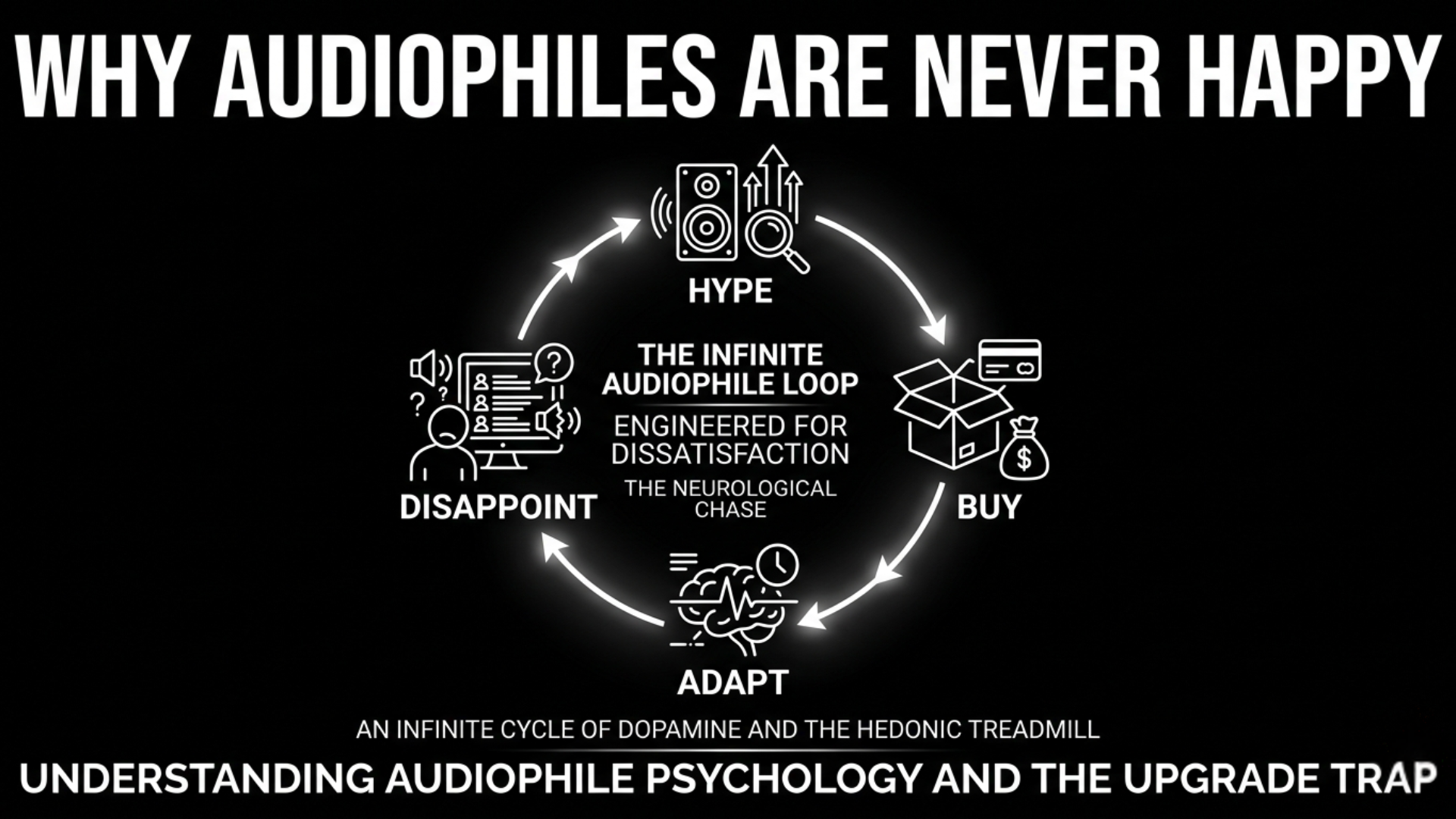
Every audiophile on Earth runs the exact same loop, whether they admit it or not. It looks like this:
It always starts with hype. A new IEM drops, a new discrete ladder DAC is announced, or a reviewer discovers a new “giant killer.” Your brain immediately latches onto it.
We often mistake this feeling for joy, but neurologically, it’s just dopamine. And dopamine is not the chemical of pleasure; it is the chemical of pursuit.
The act of researching gear—devouring reviews, analyzing frequency graphs, and imagining how much better your music will sound—is when your brain is at its highest point. The peak of the hobby happens before you even enter your credit card information. You think the joy comes from owning the gear, but it actually comes from wanting it.
The Arrival and Hedonic Adaptation
Then, the box arrives. You unbox it, plug it in, and cue up your reference track. You hear new details. You feel a wave of relief and satisfaction.
But within a few days, the magic fades. The gear didn’t degrade; your brain simply normalized it. This is hedonic adaptation. Your brain treats permanent improvements like background noise once it learns them. Yesterday’s “wow” inevitably becomes today’s “normal.” And once something becomes normal, the dopamine stops firing.
The Marketplace Symptom: Look at audio forums and classifieds every January. They flood with listings marked “Mint condition,” “Barely used,” or “Didn’t quite synergize with my chain.” Translated from audiophile-speak, this simply means: The dopamine ran out. These buyers didn’t purchase the wrong gear; they bought a feeling that had an expiration date.
The Industry Secret: Selling Flavors, Not Fidelity
This endless cycle of dissatisfaction is not an accident. It is how the high-end audio industry survives.
Audio technology hit a functional performance ceiling years ago. Once a digital-to-analog converter (DAC) is measurably transparent and an amplifier is perfectly linear, there is no higher fidelity to sell. You cannot get more accurate than accurate.
Because the industry could no longer sell true accuracy, it began selling difference.
[Truth/Accuracy]
       │
       ▼ (Market Saturation)
[Flavors of Distortion] ──► Warm / Analytical / Musical / Organic / Reference
Words like warm, analytical, musical, organic, and reference rarely describe proximity to original master tapes. Instead, they describe subtle flavors of distortion—harmonic colorations dressed up as technical progress. They are sidegrades packaged as upgrades.
The Nomenclature of Obsolescence
Look closely at how products are named: MKII, Pro, V2, Anniversary Edition.
Your perfectly functional, beautiful-sounding device is rendered obsolete overnight not because the physics of sound changed, but because a label did. Audiophile gear operates as a totem—a signal of status, refinement, and expertise. When a manufacturer drops a new version, your totem is downgraded. The resulting discomfort you feel isn’t sonic; it’s psychological.
The Illusion of Transparency
Our ears are attached to a brain that lies to us constantly. Price, expectation, brand prestige, and visual aesthetics heavily dictate what we think we hear.
This is exactly why the community fiercely avoids blind ABX testing. If a massive $2,000 interconnect cable sounds identical to a standard $20 studio cable when you don’t know which one is plugged in, the illusion dies. And illusions in this hobby are expensive.
| Component | $200 Tier | $2,000+ Tier |
| DAC | Audibly transparent; adds no sound of its own. | Cannot be “more transparent”; relies on aesthetic build or structural flavor. |
| Amplifier | Delivers clean, linear power past the human hearing threshold. | Often introduces deliberate harmonic coloration under the guise of “musicality.” |
| Upgrades | Functional, measurable leaps in performance. | A “flavor carousel” where you pay to shift the sound sideways. |
“Almost” is the most profitable word in audio. The industry thrives by whispering that your system is almost there, keeping you spinning on the upgrade ladder.
The Myth of Burn-In and the Shift to Jewelry
The psychological tricks run deep. Consider the industry’s obsession with “burn-in.” While mechanical transducers (like headphones and speakers) undergo very minor initial suspension settling, hundred-hour component burn-in cycles are largely a myth.
The electronics aren’t changing; your auditory cortex is. Your brain learns the new frequency response and stops fighting it. Harsh treble gradually registers as “high detail”; a thin midrange becomes “clean.” By the time the return window closes, you’ve adapted. The system didn’t improve—you just gave up resisting it.
At the absolute peak of the market, performance plateaus entirely and aesthetics take over.
Budget Audiophiles  ──────► Chase Performance
High-End Audiophiles ───► Chase Identity & Status
Six-figure amplifiers, gold-plated chassis, and milled aluminum thicker than an anvil aren’t about audio engineering anymore; they are luxury jewelry. When audible upgrades are gone, visible upgrades take their place.
How to Break the Loop
To escape the cycle, you don’t have to stop buying gear entirely. You just have to change the target.
If you want a massive, measurable, and undeniable acoustic upgrade, stop looking at electronics. Look at your environment.
-
The Room: The physical dimensions, furniture, and acoustic reflections of your room matter orders of magnitude more than a DAC upgrade.
-
The Treatment: Adding bass traps, diffusion panels, or simply positioning your speakers correctly yields massive performance jumps.
But acoustic treatment is boring. It has no sleek unboxing experience, poor resale value, and generates zero dopamine. The loop demands shiny new objects.
Embracing “Enough”
[The Content Consumer] ──► Stops reading spec sheets ──► Quits forum scrolling ──► Enjoys the music
There is a version of this hobby that is inherently peaceful. It involves one solid system, properly set up, and thoroughly understood. In this space, music becomes the focal point rather than the tool used to test the equipment.
“Enough” is the most dangerous word in the audio industry because it breaks the loop. The moment you stop chasing novelty, the market loses its grip on you. Audiophiles aren’t unhappy because they lack good gear; they’re unhappy because they’ve been conditioned to view satisfaction as a flaw. Turn off the forums, put on your favorite album, and just listen.
This Blog is written basis on this video by TWX:
Leave a Reply